Forex Trading Risk — Indian Traders
Most Forex brokers reviewed on this site are offshore platforms not regulated by SEBI or RBI. Trading Forex through offshore brokers from India may be inconsistent with FEMA 1999 and RBI Master Directions on Foreign Exchange. Retail Forex trading on international brokers carries both financial risk (you can lose your capital) and regulatory risk (potential legal implications under Indian law). Consult a SEBI-registered financial adviser before depositing funds.
In This Guide (8 sections)
Statutory Basis: RBI Alert List of Entities Neither Authorised to Deal in Forex Nor Authorised to Operate ETP
Entities featured on the RBI Alert List are officially flagged for unauthorized forex dealing and electronic platform operation under FEMA 1999. Depositing funds with listed platforms exposes users to total loss of regulatory recourse.
What Is the RBI Alert List?
The Reserve Bank of India publishes an Alert List — formally called the list of unauthorised forex dealing entities — naming companies not permitted to solicit or deal in foreign exchange transactions with Indian residents under FEMA 1999.
To be clear about what this means: if a company appears on the RBI alert list, trading with them from India exposes you to FEMA violation risk, and more practically, to significant risk of losing your money with zero regulatory support for recovery. The RBI cannot compel offshore platforms to return funds to Indian traders who have been defrauded.
SEBI issues parallel advisories about entities offering illegal investment schemes, binary options platforms, and unauthorised collective investment schemes. Together, these two regulatory bodies represent the core of India's investor protection framework — limited as that framework is against offshore platforms that simply ignore it.
Official Primary Source
RBI-Flagged and Unauthorised Entities
The RBI regularly updates its list of unauthorised forex dealers. These entities have been found to be soliciting forex trading from Indian residents without RBI authorisation. The list includes both Forex and binary options platforms.
Rather than reproducing the full legal text (which you should read at rbi.org.in), here's the practical summary: any broker offering to trade forex or binary options from India that is not operating through a SEBI-registered exchange (NSE/BSE currency segment) is operating outside the RBI's authorised framework. That includes the vast majority of offshore brokers discussed on this site.
The key distinction is between "flagged" (explicitly named in RBI advisories) and "unauthorised" (technically outside the framework but not explicitly named). The former is obviously worse — the RBI has specifically received complaints or identified the entity as operating illegally. The latter is the grey area that most offshore Forex brokers occupy.
| Platform | Type | Regulatory Status | Risk Level |
|---|---|---|---|
| Binomo | Binary Options | Listed on official RBI Alert List + SEBI Advisory | Very High |
| Quotex | Binary Options | Listed on official RBI Alert List | Very High |
| Olymp Trade | Binary/Forex | Listed on official RBI Alert List | Very High |
| Expert Option | Binary Options | Not RBI Authorised (Unlicensed ETP) | High |
| Deriv.com | Binary/Forex | Not SEBI Registered / Not RBI Authorised | Moderate-High |
| IQ Option | Binary/Forex | Not SEBI Registered (Offshore Seychelles entity) | Moderate |
| Various 'Guaranteed Return' Telegram groups | Signal/Scam | Multiple Police FIRs filed | Extreme |
Warning
This table is indicative, not exhaustive. Check rbi.org.in and sebi.gov.in directly for official lists. Regulatory status changes. A platform not listed here is not necessarily approved by Indian regulators.
SEBI Forex and Investment Warnings
SEBI has issued investor alerts specifically about platforms promising guaranteed returns from Forex or binary options trading. The common patterns SEBI has flagged include:
- Platforms offering "sure returns" or "guaranteed profits" from Forex trading
- WhatsApp and Telegram groups promising 20-30% monthly returns from trading signals
- Platforms requiring you to "invest" a minimum amount to access "premium signals"
- Binary options platforms marketed as fixed-income alternatives
- Recovery scams targeting traders who have already lost money (a particularly cynical sub-industry)
- Fake regulatory certificates or fabricated RBI/SEBI approval claims
The pattern is consistent enough that if something sounds too good to be true in the Indian online trading space, it almost certainly is. Legitimate brokers don't promise guaranteed returns. Legitimate signal services don't promise 90% win rates. The market doesn't work that way, and anyone claiming otherwise is either deluded or fraudulent. (Often both.)
Binary Options Platform Warnings for Indian Traders
Binary options platforms occupy a particularly problematic space for Indian traders. SEBI has not explicitly authorised any binary options platform for Indian retail traders. Binary options as financial instruments don't have a legal framework in India the way equity, currency derivatives, or commodity futures do.
This means all binary options platforms accepting Indian traders do so as offshore entities, with no Indian regulatory protection, and with the platform serving as both counterparty and house. In a structure where the broker profits from your losses (as many binary brokers do), the incentives are not aligned with your interests. (The market has enough people donating liquidity without adding a structural house edge to the equation.)
The most significant SEBI action has been around Binomo, which received an explicit SEBI advisory and has been referenced in multiple cybercrime complaints from Indian states. If you see Binomo advertised — particularly through social media influencers — treat it as a significant warning sign.
Read Our Binary Options Scams Guide
Before using any binary options platform, read our detailed guide on common scams targeting Indian traders and how to identify them.
Cybercrime-Reported Platforms in India
Beyond SEBI and RBI advisories, Indian Cyber Crime Coordination Centre (I4C) data and state-level cybercrime cell reports have referenced multiple platforms specifically. Forex and trading fraud has been one of the fastest-growing cybercrime categories in India over the past three years.
The typical complaint pattern: trader deposits money, is shown profitable paper trades (or even allowed to withdraw small amounts initially to build trust), then attempts a large withdrawal which is refused or subjected to "tax requirements" that are themselves fraudulent.
If you or someone you know has experienced this, the complaint mechanism is cybercrime.gov.in or the National Cybercrime Reporting Portal, plus your local police cybercrime cell. Recovery rates are low, but complaints help the authorities identify patterns and build cases against repeat offenders.
What to Do If Your Broker Is on the Alert List
- Stop depositing immediately.Do not send more money to an entity on the alert list, regardless of what promises the platform makes about "withdrawal unlock fees" or "verification requirements."
- Initiate a withdrawal request. Document everything. Screenshot your account balance, your withdrawal request, and all communication with the platform.
- Contact your bank.If you deposited by debit/credit card, ask about chargebacks. Success depends on your bank and the timeline, but it's worth attempting.
- File a cybercrime complaint. Go to cybercrime.gov.in and file a report. Include all transaction records, screenshots, and communication.
- Consult a lawyer. If significant amounts are involved, a lawyer familiar with cybercrime and FEMA law can advise on your options.
- Do not engage with recovery scammers. Entities that approach you claiming to recover your lost funds for an upfront fee are almost universally scams themselves.
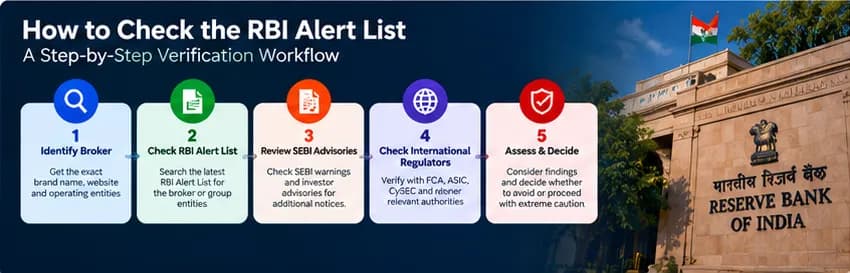
How to Verify a Broker Before Depositing
Before giving any platform your money, run through this checklist. It takes fifteen minutes. It could save you years of regret.
- 1Check the platform against the RBI Alert List at rbi.org.in/Scripts/BS_ViewAlertlist.aspx
- 2Search the SEBI investor advisories at sebi.gov.in for the platform name
- 3Verify the broker's claimed regulation on the regulator's own website (FCA Register, ASIC Connect, CySEC register)
- 4Search '[Broker Name] scam India' and '[Broker Name] withdrawal problems' — see what actual users report
- 5Check cybercrime.gov.in complaint categories for the broker name
- 6Search the National Consumer Helpline (1800-11-4000) database
- 7Never trust screenshots of regulation certificates — verify directly with the regulator
Tip
Frequently Asked Questions
Editor & Financial Researcher
Last updated
May 2026
Editor and financial researcher at BinaryOptionTrading.in. Focuses on retail trading platforms, SEBI/RBI regulations, and trader education. About our research & editorial team.
Editorial Transparency & Integrity
BinaryOptionTrading.in is a research and educational publication. Our evaluations are built on structured document research, regulatory registry cross-referencing, and fee schedule analysis under Indian market context. Proprietary trading firms (prop firms) operate evaluation and demo account services and are not SEBI-regulated financial brokers or deposit-taking institutions. We do not modify ratings or omit regulatory warnings in exchange for sponsor payouts. Read our full Review Methodology and Editorial Standards.
Forex Trading Risk — Indian Traders
Most Forex brokers reviewed on this site are offshore platforms not regulated by SEBI or RBI. Trading Forex through offshore brokers from India may be inconsistent with FEMA 1999 and RBI Master Directions on Foreign Exchange. Retail Forex trading on international brokers carries both financial risk (you can lose your capital) and regulatory risk (potential legal implications under Indian law). Consult a SEBI-registered financial adviser before depositing funds.