Forex Trading Risk — Indian Traders
Most Forex brokers reviewed on this site are offshore platforms not regulated by SEBI or RBI. Trading Forex through offshore brokers from India may be inconsistent with FEMA 1999 and RBI Master Directions on Foreign Exchange. Retail Forex trading on international brokers carries both financial risk (you can lose your capital) and regulatory risk (potential legal implications under Indian law). Consult a SEBI-registered financial adviser before depositing funds.
In This Guide (9 sections)
What Is Forex Trading
The foreign exchange market — forex, FX, currency market, whatever you prefer — is where currencies are bought and sold against each other. EUR/USD. USD/INR. GBP/JPY. You are simultaneously buying one currency and selling another, speculating on whether the exchange rate will move in your favour.
It is the largest financial market in the world by volume — approximately $7.5 trillion traded daily as of recent BIS surveys. That sounds impressive, and it is. It also means you are competing against central banks, hedge funds, high-frequency trading algorithms, and every other retail trader on the planet who thinks they have figured out where EUR/USD is going on a Tuesday afternoon.
Forex operates 24 hours a day, five days a week. The main trading sessions overlap at different times — Sydney, Tokyo, London, New York. For Indian traders in IST, the London session opens around 1:30 PM and the New York session starts around 6:30 PM. The London-New York overlap (roughly 6:30 PM to 8:30 PM IST) is when liquidity and volatility tend to peak. See our comprehensive guide on the best time to trade forex in India for hour-by-hour session schedules and volume breakdowns.
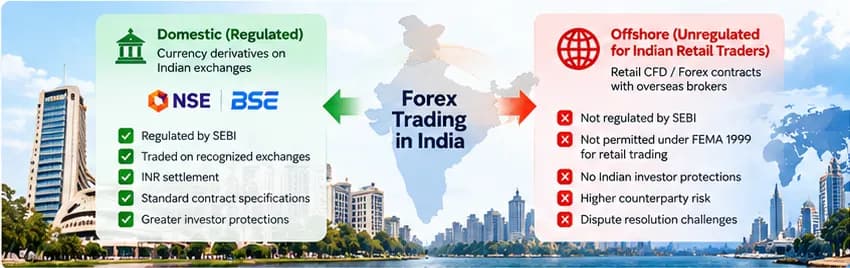
Forex vs Currency Derivatives
The Legal Status of Forex Trading in India
This is where most articles get either deliberately vague or factually wrong. For a comprehensive statutory analysis of RBI notifications, SEBI circulars, and FEMA provisions, consult our central guide on is forex trading legal in India.
What is clearly legal: Trading currency derivatives (futures and options) on SEBI-regulated exchanges — NSE, BSE, or Metropolitan Stock Exchange (MSE) — through a SEBI-registered broker. The permissible currency pairs are limited to USD/INR, EUR/INR, GBP/INR, and JPY/INR, plus cross-currency pairs EUR/USD, GBP/USD, and USD/JPY where available.
What sits in a grey area: Using offshore forex brokers to trade international forex markets. This involves remitting money abroad under the Liberalised Remittance Scheme (LRS), and whether speculative forex trading qualifies as a permitted LRS purpose is legally contested. The RBI`s Master Directions and FEMA 1999 restrict speculative foreign currency transactions by Indian residents.
What is clearly illegal: Forex trading platforms that accept deposits in INR and operate without any regulatory licence. These are illegal under both FEMA and the Payment and Settlement Systems Act. Several such platforms have been shut down, and ED (Enforcement Directorate) action has been taken.
RBI Position
Currency Pairs Permitted on Indian Exchanges

If you want to trade forex entirely within the legal framework, these are the pairs available to you on SEBI-regulated Indian exchanges:
| Currency Pair | Exchange | Contract Type | Settlement |
|---|---|---|---|
| USD/INR | NSE, BSE, MSE | Futures & Options | Cash (INR) |
| EUR/INR | NSE, BSE, MSE | Futures & Options | Cash (INR) |
| GBP/INR | NSE, BSE, MSE | Futures & Options | Cash (INR) |
| JPY/INR | NSE, BSE, MSE | Futures & Options | Cash (INR) |
| EUR/USD | NSE, BSE | Futures | Cash (INR) |
| GBP/USD | NSE, BSE | Futures | Cash (INR) |
| USD/JPY | NSE, BSE | Futures | Cash (INR) |
These contracts are much more limited than the 50+ pairs available on offshore platforms. No gold, no indices, no exotic currencies. If your trading strategy requires pairs beyond this list, you are looking at offshore brokers — and accepting the legal and financial risks that come with them.
Offshore Forex Brokers and Indian Traders
The reality on the ground is that a significant portion of Indian retail forex traders use offshore platforms like XM, FxPro, EightCap, and AvaTrade. These brokers are not regulated by SEBI or RBI — they hold licences from regulators in their home jurisdictions (CySEC, ASIC, FCA).
These brokers are not illegal in their home jurisdictions. The legal question is whether Indian residents are permitted to remit money to them and trade through them under Indian law. The honest answer is that this is legally ambiguous, and ambiguity in financial regulation is not the same as permissibility.
Practically speaking, hundreds of thousands of Indian traders use these platforms without incident. Enforcement is selective and tends to focus on larger-scale operations, platforms operating in INR without proper licensing, and clear fraud cases. But "enforcement hasn't happened to me yet" is not the same as "this is legal."
For Indian traders who proceed with offshore brokers
How to Start Forex Trading in India
The legal path for beginners: open a Demat and trading account with a SEBI-registered broker (Zerodha, Upstox, ICICI Direct, HDFC Securities, Angel One) and trade currency derivatives on NSE or BSE. For a complete step-by-step walkthrough covering KYC, platform download, and practice accounts, read our guide on how to start forex trading in India.
The steps are the same as opening a stock trading account: PAN card, Aadhaar-based KYC, bank account linkage, and you're trading. The margin requirements for USD/INR futures are typically in the range of ₹2,000–₹5,000 per lot depending on the broker and current volatility requirements.
If you want to trade international pairs on offshore platforms — acknowledging the legal considerations above — the process involves registering with the broker (straightforward), completing KYC (passport or government ID), and depositing funds. Most offshore brokers require international card deposits or Skrill/Neteller funded via Indian bank transfer. Bank wire is supported universally but takes 2-5 business days to clear. Once your account is funded, developing a structured trading methodology is critical — explore our complete overview of forex trading strategies in India covering price action, SMC/ICT, scalping, and swing trading.
Real Risks for Indian Forex Traders

Beyond the regulatory risk discussed above, forex trading carries substantial financial risk. The ESMA (European regulator) data shows that 74–89% of retail CFD accounts lose money. For Indian traders on offshore platforms, there are additional layers:
- Leverage risk: Offshore brokers may offer leverage up to 1:500 or 1:1000. This amplifies losses as readily as gains. A 0.1% move against a 1:500 leveraged position wipes out 50% of your margin.
- Counterparty risk: If the broker fails or refuses withdrawals, Indian traders have limited legal recourse. Even with a well-regulated broker, compensation schemes may not cover Indian residents.
- Currency conversion risk: You are depositing INR, trading in USD/EUR positions. The exchange rate on conversion adds friction to both deposits and withdrawals.
- Legal and tax risk: Undeclared offshore trading income is a tax violation. ED action under FEMA, while not routine, has happened to retail traders.
Forex Trading Risk — Indian Traders
Most Forex brokers reviewed on this site are offshore platforms not regulated by SEBI or RBI. Trading Forex through offshore brokers from India may be inconsistent with FEMA 1999 and RBI Master Directions on Foreign Exchange. Retail Forex trading on international brokers carries both financial risk (you can lose your capital) and regulatory risk (potential legal implications under Indian law). Consult a SEBI-registered financial adviser before depositing funds.
Best Platforms for Forex Trading from India
For legal currency derivatives trading on Indian exchanges, the main brokers are Zerodha (Kite), Upstox, Angel One, ICICI Direct, and HDFC Securities. Platform quality is broadly similar across these for currency derivatives.
For offshore forex platforms popular with Indian traders, our full comparison is at Best Forex Brokers India 2026. The short version:
- XM: $5 minimum, strong education, MT4/MT5. Best for complete beginners with small capital.
- FxPro: FCA-group regulated, NDD execution, 4 platforms including cTrader. Best regulation pedigree.
- EightCap: ASIC + FCA, TradingView integration, raw spreads from 0.0 pips. Best for active traders.
- AvaTrade: 6 regulatory jurisdictions, fixed spreads, beginner-friendly. Best for risk-averse starters.
Compare All Forex Brokers for India
Eight brokers compared on spreads, regulation, Indian deposit options, and execution quality. With honest risk notes on each.
Tax on Forex Trading Profits in India
Forex trading income is taxable in India. The tax treatment depends on how you trade and declare it:
- Currency derivatives gains on Indian exchanges are typically treated as speculative business income and taxed at your applicable income tax slab rate.
- Offshore trading income must be declared in your ITR under the foreign income schedule. The income is taxed at your slab rate.
- TDS (Tax Deducted at Source) is applicable on certain foreign remittances under LRS — check with your bank on current LRS TCS rules, as these have changed in recent years.
- If you are carrying forward losses from forex trading, keep detailed records — the tax treatment of speculative vs non-speculative business losses affects how these can be offset.
The above is general information, not tax advice. Consult a CA who understands both FEMA and income tax before making filing decisions on offshore trading income. The intersection of FEMA compliance and income tax declaration is an area where generalist advice can go wrong.
Official Regulatory References & Sources
- • Reserve Bank of India (RBI): Official RBI Web Portal — Master Direction on Risk Management and Inter-Bank Dealings and guidelines on LRS remittances.
- • Foreign Exchange Management Act (FEMA), 1999: FEMA 1999 Legislative Text on India Code — Provisions regarding foreign currency transactions, current account regulations, and restrictions.
- • Securities and Exchange Board of India (SEBI): Official SEBI Portal — Advisory circulars concerning authorized currency futures/options brokers on NSE and BSE.
Frequently Asked Questions — Forex Trading India
Editor & Financial Researcher
Last updated
2026-05-01
Editor and financial researcher at BinaryOptionTrading.in. Focuses on retail trading platforms, SEBI/RBI regulations, and trader education. About our research & editorial team.
Editorial Transparency & Integrity
BinaryOptionTrading.in is a research and educational publication. Our evaluations are built on structured document research, regulatory registry cross-referencing, and fee schedule analysis under Indian market context. Proprietary trading firms (prop firms) operate evaluation and demo account services and are not SEBI-regulated financial brokers or deposit-taking institutions. We do not modify ratings or omit regulatory warnings in exchange for sponsor payouts. Read our full Review Methodology and Editorial Standards.
Forex Trading Risk — Indian Traders
Most Forex brokers reviewed on this site are offshore platforms not regulated by SEBI or RBI. Trading Forex through offshore brokers from India may be inconsistent with FEMA 1999 and RBI Master Directions on Foreign Exchange. Retail Forex trading on international brokers carries both financial risk (you can lose your capital) and regulatory risk (potential legal implications under Indian law). Consult a SEBI-registered financial adviser before depositing funds.